

Lost Airlines — People Express Airlines
People Express Airlines (1981–1987)
The purest experiment in airline deregulation — a Newark-based ultra-low-cost carrier that charged $23 to fly to Boston and briefly became the fifth-largest US airline. Alfred Kahn called it his favourite child. It grew too fast, lost its way, and was gone within six years.
Founded in Newark, New Jersey
Newark–Boston one-way fare at launch
Absorbed by Continental Airlines
Heritage
Flying for the Price of a Bus Ticket
People Express Airlines was founded in 1981 by Donald Burr, a former Texas International executive who had absorbed the lessons of deregulation and taken them to their logical extreme. Operating from the unfashionable North Terminal at Newark Liberty, People Express stripped the airline product to its bare minimum: no assigned seats, no free meals, no travel agents, no interline agreements. Passengers paid for everything separately — even checked baggage. In return, they got fares that were genuinely revolutionary. The $23 Newark-to-Boston fare was not a promotional gimmick; it was the standard price. For the first time, millions of Americans who had never flown could afford to.
Identity
Red, White, and Radical
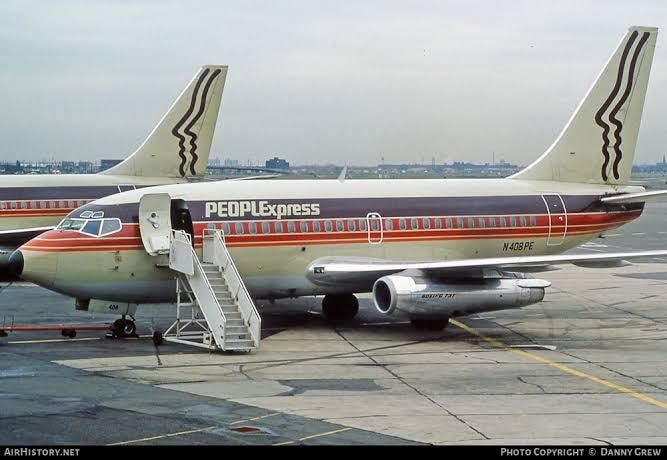
People Express wore its populist identity on its fuselage. The livery — a clean white aircraft with a bold red and blue stripe and the word People in a confident sans-serif — was deliberately unpretentious. There was no attempt at the glamour of Pan Am or the artistry of Braniff. The design said: this is an airline for everyone, not just the business traveller or the wealthy tourist. The cabin matched the exterior — basic, functional, and unapologetically no-frills. Flight attendants collected fares in-flight using handheld devices. It was chaotic, occasionally shambolic, and enormously popular.
The End
Growth Without Infrastructure
People Express grew at a pace that its systems could not support. By 1985 it was carrying 10 million passengers a year and had become the fifth-largest US airline. Then Burr made a series of fatal decisions. He acquired Frontier Airlines in 1985, a full-service carrier with a completely different cost structure and culture. He added transatlantic routes to London. He moved upmarket, adding amenities that destroyed the cost discipline that had made People Express possible. Meanwhile, the legacy carriers — American, United, Delta — had developed sophisticated yield management systems that allowed them to match People Express fares on specific seats while maintaining higher prices elsewhere. By 1986 People Express was losing money on every route it flew.
Deregulation
Kahn's Favourite Child
Alfred Kahn, the Cornell economist who as CAB chairman drove through deregulation, was openly fond of People Express. It was, he said, exactly what deregulation was supposed to produce: a new entrant that used competition to drive down fares and open air travel to people who had previously been priced out. The airline demonstrated that the theory worked — fares fell dramatically on every route People Express entered. But it also demonstrated the theory's limits. A market without barriers to entry is also a market without protection from the incumbents' response. The legacy carriers' yield management systems were a competitive weapon that a startup with no technology infrastructure and no financial reserves could not match.
Legacy
The Dream That Proved the Point
People Express was absorbed by Continental Airlines in February 1987, ending one of the most remarkable six-year runs in American aviation history. Donald Burr later said he had made every mistake possible in the second half of the airline's life, having made almost none in the first. The legacy of People Express is complicated. It proved that ultra-low-cost flying was possible and that there was enormous latent demand for cheap air travel. It also proved that a low-cost carrier needed iron discipline to survive — a lesson that Southwest Airlines had already learned and that Ryanair and easyJet would later apply with ruthless consistency. People Express was the prototype. It just did not survive long enough to become the finished product.
Frequently Asked Questions
Common Questions
Why did People Express Airlines fail?+
People Express collapsed because it grew faster than it could manage. Its low fares created extraordinary demand, but the airline's systems could not scale at the same pace. When it acquired Frontier Airlines in 1985, it inherited a unionised workforce and a cost structure incompatible with its ultra-low-cost model. Meanwhile, the legacy carriers deployed early yield management software to match People Express fares on specific seats, eliminating its price advantage. By 1986 it was losing $1 million a day.
How cheap were People Express fares?+
People Express launched in 1981 with fares as low as $23 between Newark and Buffalo — at a time when the legacy carriers charged over $100 for the same route. Its Newark to London fare of $149 one-way was less than half of what British Airways and TWA charged. The airline achieved these prices through radical cost-cutting: passengers paid separately for checked bags and snacks, and aircraft were kept in the air for maximum hours.
Did People Express inspire Ryanair and easyJet?+
Directly, yes. Ryanair's transformation into a low-cost carrier in 1991 was explicitly modelled on the People Express and Southwest Airlines template. Michael O'Leary studied both carriers before implementing Ryanair's no-frills model. EasyJet's Stelios Haji-Ioannou similarly cited the deregulation-era US carriers as inspiration. The unbundling of fares that People Express pioneered in the early 1980s is now the standard business model for low-cost carriers worldwide.
Who founded People Express Airlines?+
Donald Burr founded People Express in 1981 after leaving Texas International Airlines. Burr's vision was idealistic as well as commercial — he wanted to create an airline where employees were genuine stakeholders, with every worker required to own shares and rotate between roles. At its peak, People Express carried 10 million passengers a year and was the fifth-largest US carrier. Burr's story — visionary founder, spectacular growth, catastrophic collapse — became one of the defining business narratives of the deregulation era.