

Lost Airlines — Midway Airlines
Midway Airlines (1976–1991)
Chicago's hometown low-cost pioneer, Midway Airlines was born the very day deregulation passed and built its entire identity around the neglected airport that the majors had abandoned. It proved that a secondary airport could anchor a profitable airline — then fell victim to the same competitive forces it had helped unleash.
Founded in Chicago
Original Chicago–Detroit one-way fare
Ceased operations
Heritage
The Airport the Majors Forgot
Midway Airlines was incorporated in 1976 and launched operations on 31 October 1979 — the very day the Airline Deregulation Act took effect. Its founders chose Chicago Midway Airport deliberately: the majors had all migrated to O'Hare, leaving Midway underused, uncongested, and close to the city's South Side. Midway offered fares that undercut the established carriers by 40 to 50 per cent on key routes, and passengers responded immediately. The airline grew rapidly through the early 1980s, adding routes to the East Coast and building a loyal base of business travellers who valued the shorter taxi times and easier parking that Midway Airport offered over the chaos of O'Hare.
Identity
Clean Lines and Corporate Confidence
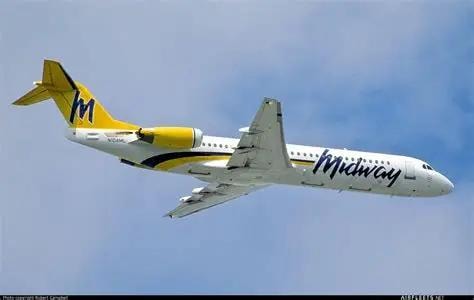
Midway's livery was a study in restrained corporate confidence — a white fuselage with a bold red and navy blue cheatline running the length of the aircraft, and the Midway name in strong block lettering. It was not as flamboyant as Braniff or as playful as PSA, but it communicated exactly what Midway wanted to say: serious, reliable, and affordable. The livery suited the airline's positioning perfectly — a no-nonsense alternative to the legacy carriers, with enough visual polish to attract the business traveller.
Collapse
Squeezed from Above and Below
Midway's collapse came in two stages. The first crisis arrived in 1983, when the airline overextended into longer routes it was not equipped to serve profitably. A restructuring followed, and Midway emerged leaner and more focused. The second and fatal crisis came in 1990–91. Midway had acquired Midway Metrolink and was attempting to build a hub operation when the Gulf War sent fuel prices soaring and the recession destroyed demand. The airline suspended operations in November 1991, stranding passengers and staff with almost no warning. A brief attempt at revival failed within days.
Deregulation
A Child of Deregulation, Killed by Its Consequences
Midway Airlines was, more than almost any other carrier, a pure product of deregulation. It could not have existed under the CAB regime — the routes it needed, the fares it charged, and the airport strategy it pursued were all impossible under regulation. Deregulation created Midway, and deregulation's consequences destroyed it. The same competitive pressure that had allowed Midway to undercut the majors in 1979 was turned against it by the early 1990s, when the majors had learned to match low fares on contested routes while absorbing losses that a smaller carrier could not sustain.
Legacy
The Pioneer That Proved the Model
Midway Airlines deserves more credit than it typically receives in the history of US aviation. It demonstrated, before Southwest had expanded beyond Texas, that a low-cost carrier based at a secondary airport could build a profitable and loyal customer base in a major metropolitan market. The model it pioneered — cheap fares, secondary airports, point-to-point routes — became the template for the low-cost revolution of the 1990s and 2000s. The original Midway was a genuine innovator, and its story is inseparable from the story of what deregulation made possible.
Frequently Asked Questions
Common Questions
When did Midway Airlines start flying?+
Midway Airlines launched its first flights on 31 October 1979 — the very day the Airline Deregulation Act officially took effect. The timing was deliberate: the founders had been waiting for deregulation to make their low-fare model viable. The inaugural route was Chicago Midway to Cleveland, with a one-way fare of $38, roughly half what the established carriers were charging.
Why did Midway Airlines choose Midway Airport over O'Hare?+
Midway Airport had been largely abandoned by the major carriers in the 1960s and 1970s as they migrated to O'Hare International. This left Midway Airport with spare capacity, lower landing fees, and far less congestion. The airline's founders saw this as a competitive advantage: shorter taxi times, easier parking, and a location closer to Chicago's South Side and downtown. The strategy worked — Midway Airport's passenger numbers grew dramatically after the airline launched.
What caused Midway Airlines to collapse in 1991?+
Midway's final collapse was triggered by the Gulf War fuel price spike and the 1990–91 recession, which together destroyed the airline's financial position at a moment when it had taken on significant debt to fund expansion. The airline had acquired Midway Metrolink and was attempting to build a hub operation, stretching its resources beyond what the market conditions could support. Operations were suspended in November 1991 with almost no warning to passengers or staff.
Is there a connection between the original Midway Airlines and later carriers using the name?+
The Midway name was used by two subsequent carriers, but neither had any operational or ownership continuity with the original. Midway Airlines Inc. launched in 1993 and operated until 2003, when it too filed for bankruptcy. The original Midway Airlines — the deregulation pioneer founded in 1976 — was a distinct entity from all of these successors.