

Lost Airlines — Braniff International Airways
Braniff International Airways (1928–1982)
The most visually audacious airline in American history — Alexander Calder painted their planes, Emilio Pucci dressed their cabin crew, and Halston designed their uniforms. Deregulation's first major casualty, Braniff collapsed in 1982 just four years after the Act it had lobbied to pass.
Founded in Oklahoma City
Alexander Calder aircraft designs
First major deregulation casualty
Heritage
The End of the Plain Plane
Braniff International was founded in 1928 by Tom Braniff in Oklahoma City, but it was under Harding Lawrence in the 1960s that it became something genuinely extraordinary. Lawrence hired designer Alexander Girard to reimagine every aspect of the passenger experience — the aircraft liveries, the interiors, the lounges, the menus. In 1965 he launched the End of the Plain Plane campaign, painting Braniff's fleet in a palette of solid, saturated colours: ochre, turquoise, orange, beige, and a vivid ultramarine. No other airline had ever done anything like it. Braniff was not just an airline; it was a design statement.
Identity
Calder, Pucci, and the Flying Colours
The pinnacle of Braniff's visual ambition came in 1973, when Alexander Calder — the sculptor famous for his mobiles — was commissioned to paint two Boeing 727s as flying canvases. The results were extraordinary: abstract compositions in primary colours that turned the aircraft into kinetic art. Emilio Pucci designed the cabin crew uniforms, and later Halston took over. No airline before or since has assembled a design team of comparable stature. The Braniff livery was not a corporate identity exercise; it was a genuine artistic programme, and it made every other airline's colour scheme look timid by comparison.
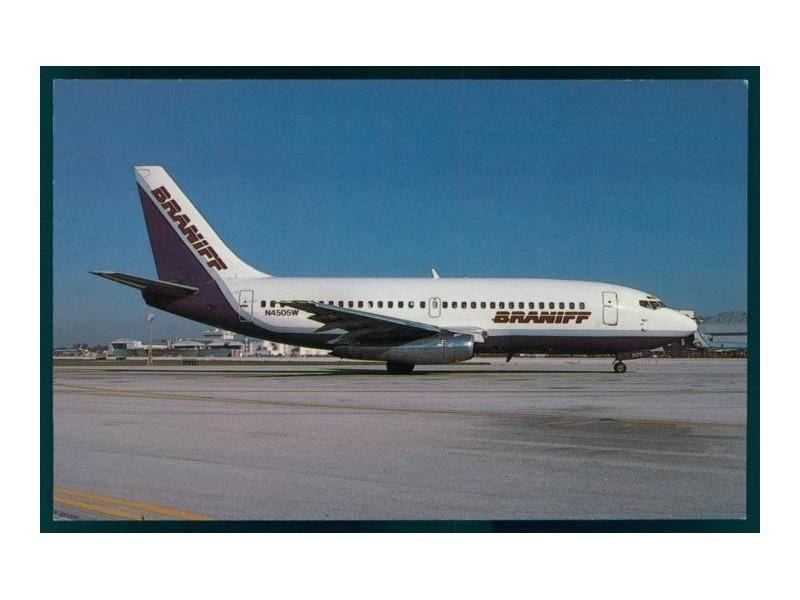
The End
Overexpansion and the Oil Shock
Braniff's collapse was swift and brutal. After deregulation in 1978, Harding Lawrence expanded aggressively — adding 32 new routes in a single day in February 1979, stretching the airline's resources to breaking point. The timing was catastrophic: the second oil crisis of 1979 sent fuel costs soaring, and the recession of 1980–81 destroyed demand. Braniff had taken on enormous debt to fund its expansion and had no reserves to absorb the shock. On 12 May 1982, Braniff International became the first major US airline to cease operations since deregulation. All flights stopped simultaneously. Passengers were stranded mid-journey. It was a spectacular and total collapse.
Deregulation
The Airline That Lobbied for Its Own Destruction
There is a painful irony at the heart of Braniff's story. Harding Lawrence was one of the most vocal advocates for airline deregulation in the mid-1970s, believing that a liberated market would allow Braniff to expand beyond the routes the CAB had allocated it. He was right that deregulation would bring expansion — but catastrophically wrong about Braniff's ability to manage it. The airline that helped lobby the Airline Deregulation Act into existence became its first major victim. Alfred Kahn, the architect of deregulation, later acknowledged that Braniff's collapse was a painful but necessary consequence of the new competitive environment.
Legacy
A Masterpiece That Burned Too Bright
Braniff International deserves to be remembered as one of the great what-ifs of American aviation. Had Lawrence shown more restraint after deregulation — had he expanded more carefully, taken on less debt, managed the oil shock with greater caution — the airline that Calder painted might still exist today. Instead it became a cautionary tale about the dangers of overconfidence in a newly deregulated market. The Braniff name was revived twice, in 1983 and 1991, but neither incarnation recaptured the original's spirit. The flying canvases are gone. What remains is the memory of an airline that understood, better than any other, that flying could be beautiful.
Frequently Asked Questions
Common Questions
Why did Braniff International go bankrupt?+
Braniff collapsed in May 1982, becoming the first major US airline to fail after deregulation. Its downfall was a direct consequence of over-expansion. When deregulation passed in 1978, Braniff's CEO Harding Lawrence launched 32 new routes simultaneously — a gamble that stretched the airline's finances to breaking point. The 1979 oil crisis then doubled fuel costs, the 1980 recession cut passenger numbers, and Braniff found itself with too many aircraft, too many routes, and not enough revenue.
Who painted the Braniff aircraft?+
Alexander Calder, the American sculptor famous for his mobiles, painted a Braniff Boeing 727 in 1973 as part of the airline's Flying Colours campaign. The aircraft featured Calder's bold abstract designs in red, white, and blue. It was one of several artist collaborations Braniff undertook under the creative direction of Mary Wells Lawrence. The Calder plane became one of the most iconic aircraft liveries in aviation history.
Was Braniff International revived after bankruptcy?+
Yes, twice. A new Braniff International was launched in 1984 by the Hyatt Corporation but struggled to rebuild the brand and filed for bankruptcy again in 1989. A third incarnation, Braniff Inc., launched in 1991 but lasted only until 1992. None of the successor carriers recaptured the original Braniff's scale or cultural impact.
What was Braniff's End of the Plain Plane campaign?+
In 1965, Braniff hired advertising agency Wells Rich Greene and designer Alexander Girard to completely reinvent the airline's image. The campaign replaced Braniff's conventional silver aircraft with aircraft painted in seven vivid solid colours. Flight attendants wore Pucci-designed uniforms that changed in layers during the flight. It was the most radical rebranding in airline history and made Braniff a symbol of 1960s American optimism and design innovation.