

1926 – 2010
Northwest Airlines
The great northern gateway to Asia, Northwest built one of the most enviable Pacific route networks in the world — and then watched it disappear into the Delta merger.
Years of service
First Pacific crossing
Fully merged into Delta
Heritage
The Golden Era
Northwest Airlines was the pioneer of the great circle route across the Pacific, flying from the US to Japan, Korea, and beyond via Alaska and the Aleutian Islands. Its 1947 inaugural flight to Tokyo made it the first US carrier to serve Japan after World War II, and it built a Pacific network that was the envy of the industry. Its hubs at Minneapolis-St Paul and Detroit made it the dominant carrier of the upper Midwest, and its World Business Class product was among the best in the sky.
Identity
The Iconic Livery
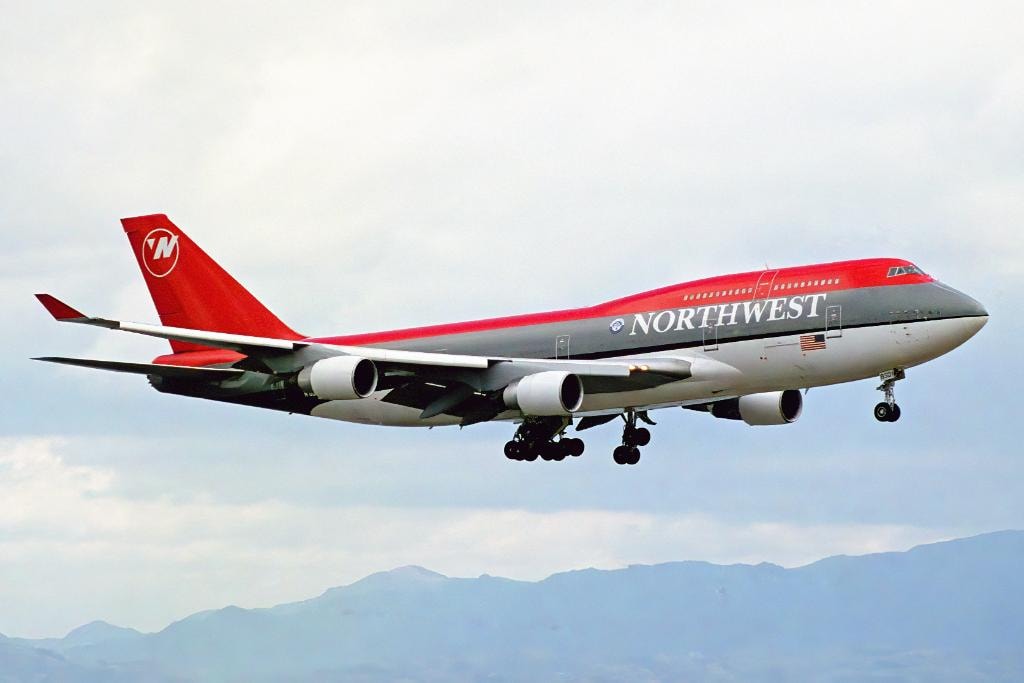
Northwest's livery went through several evolutions, but its most celebrated was the bold red and grey scheme of the 1980s and 1990s, featuring a distinctive compass-rose logo on the tail — a subtle NW that doubled as a compass pointing northwest. The design was clever, elegant, and unmistakably Northwest. When Delta absorbed the airline, the red and grey disappeared, replaced by Delta's blue — a change that Northwest loyalists mourned deeply.
The End
What Went Wrong
Northwest's merger with Delta in 2008 was the first of the great post-deregulation mega-mergers, and it set the template for the consolidation that followed. Northwest had struggled financially through the 2000s, filing for bankruptcy in 2005 alongside Delta. The merger made strategic sense — complementary route networks, combined scale — but it meant the end of Northwest as an independent brand. The last Northwest-branded flight operated on 31 January 2010.
Deregulation
Deregulation's Role
Northwest was one of the carriers that adapted most successfully to deregulation in the early years, building its hub-and-spoke network aggressively and expanding its Pacific routes. But the long-term pressures of deregulation — low-cost competition on domestic routes, fuel price volatility, the post-9/11 collapse in demand — eventually overwhelmed its finances. The bankruptcy of 2005 and the subsequent merger with Delta were the final consequences of a competitive environment that rewarded scale above all else.
Legacy
The Legacy
Northwest's Pacific legacy lives on in Delta's route network, which inherited some of the finest transpacific routes in aviation. But the Northwest brand — the compass rose, the red and grey, the distinctive culture of the upper Midwest — is gone. For the millions of passengers who flew Northwest between Minneapolis and Tokyo, between Detroit and Amsterdam, it was more than an airline. It was a connection to the world, and its disappearance left a gap that Delta has never quite filled in the hearts of its former passengers.
Frequently Asked Questions
Common Questions
Why did Northwest Airlines merge with Delta?+
Northwest merged with Delta in October 2008, creating the world's largest airline at the time. The merger was driven by financial pressure — Northwest had filed for bankruptcy in 2005 and emerged in 2007, but remained vulnerable to fuel price spikes and competition. Delta, similarly weakened, saw consolidation as the path to survival. The combined carrier kept the Delta name and Atlanta hub while retaining Northwest's Minneapolis and Detroit hubs and its dominant Pacific network.
What was Northwest Airlines known for?+
Northwest was best known for its unrivalled Pacific network, built on routes to Japan, Korea, China, and Southeast Asia that dated back to the post-war era. It was the dominant US carrier across the Pacific for decades. Domestically, Northwest was known for its Minneapolis-St. Paul and Detroit hubs, its no-frills reputation, and a famously tense relationship with its unions — it suffered multiple strikes and labour disputes throughout the deregulation era.
Did Northwest Airlines go bankrupt?+
Yes. Northwest filed for Chapter 11 bankruptcy in September 2005, the same day as Delta — a remarkable coincidence that underlined the industry's systemic crisis. The bankruptcies were triggered by record fuel prices following Hurricane Katrina and the lingering effects of post-9/11 traffic decline. Northwest used the bankruptcy to restructure labour contracts and reduce costs, emerging in May 2007 before agreeing to merge with Delta the following year.
What happened to Northwest's Pacific routes after the Delta merger?+
Northwest's Pacific routes became one of Delta's most valuable assets. Delta inherited Northwest's hubs in Tokyo Narita and its bilateral rights to fly to Japan, Korea, China, and Southeast Asia — routes that took decades to negotiate and cannot simply be replicated. Delta has since expanded the Pacific network significantly, and Northwest's Pacific expertise is widely credited as a key reason Delta pursued the merger so aggressively.