

1934 – 2012
Continental Airlines
Continental survived bankruptcy twice, reinvented itself under Gordon Bethune, and became one of America's most admired airlines — only to be absorbed into United in the final wave of mega-mergers.
Years of service
Bankruptcy filings
Merged into United Airlines
Heritage
The Golden Era
Continental's finest years came under CEO Gordon Bethune, who took over in 1994 when the airline was on the brink of its third bankruptcy. His turnaround — documented in his book 'From Worst to First' — is one of the great management stories in American business. By the late 1990s, Continental had won multiple JD Power awards for customer satisfaction and was regularly ranked among the best airlines in the world. Its hub at Houston Intercontinental and its Pacific routes made it a genuinely global carrier.
Identity
The Iconic Livery
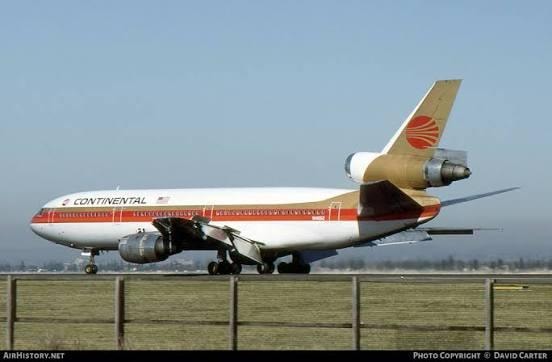
Continental's globe logo — a stylised golden globe on a blue field — was one of the most elegant in American aviation. The livery, with its blue fuselage and gold globe on the tail, projected confidence and quality. When Continental merged with United, there was genuine debate about which brand to retain — a testament to how highly regarded the Continental identity had become. United ultimately kept its own name but adopted Continental's globe logo, a partial acknowledgement of Continental's superior brand equity.
The End
What Went Wrong
Continental didn't fail — it was absorbed. The 2010 merger with United Airlines was driven by the logic of consolidation: in a post-deregulation world of thin margins and brutal competition, scale was survival. The combined United-Continental became the world's largest airline by some measures. But the merger was troubled — United's culture and Continental's culture clashed, and many Continental employees and passengers mourned the loss of an airline that had genuinely earned its reputation for quality.
Deregulation
Deregulation's Role
Continental's story illustrates both the promise and the peril of deregulation. The freedom to compete allowed Bethune to rebuild the airline on quality and service — a genuine market success story. But the same competitive pressures that drove Continental's reinvention also drove the consolidation that ultimately ended its independent existence. Deregulation created a world where only the very largest carriers could survive, and Continental, for all its excellence, was not quite large enough.
Legacy
The Legacy
Continental's legacy is complicated. It was, in its final years, a genuinely excellent airline — proof that a legacy carrier could compete on quality in a deregulated market. Its absorption into United was a loss for American aviation, even if the business logic was sound. The gold globe lives on in United's tail logo, a quiet tribute to the airline that earned it. For those who flew Continental in the Bethune years, it remains the benchmark against which other airlines are measured.
Frequently Asked Questions
Common Questions
Why did Continental Airlines go bankrupt?+
Continental filed for bankruptcy twice. The first time, in 1983, was a deliberate strategy by owner Frank Lorenzo to void union contracts and slash wages. The second bankruptcy, in 1990, was caused by the Gulf War oil price spike and a price war with low-cost carriers. Continental emerged from its second bankruptcy in 1993 under Gordon Bethune, who transformed it into one of America's best-run airlines before its merger with United in 2012.
What happened to Continental Airlines?+
Continental merged with United Airlines in October 2010, with the combined carrier operating under the United name. The merger was completed in 2012. Continental's Newark hub became a key United hub, and many Continental operational practices — including its customer service culture under Gordon Bethune — were adopted by the merged carrier. The Continental brand and livery disappeared, though the merged United initially kept Continental's globe logo before adopting a new identity.
Who was Gordon Bethune and why does he matter?+
Gordon Bethune became Continental's CEO in 1994 and engineered one of the most celebrated turnarounds in airline history. He found an airline so demoralised that employees were ashamed to wear their uniforms in public. Within two years, Continental had risen from last to first in the Department of Transportation's airline quality rankings. His book From Worst to First became a business school case study.
Was Frank Lorenzo's bankruptcy strategy legal?+
Yes, and that was precisely what made it so controversial. Lorenzo filed Continental for bankruptcy in 1983 despite the airline having sufficient cash to continue operating, using Chapter 11 specifically to reject union contracts. The courts allowed it. Congress subsequently tightened bankruptcy law to make this harder, but Lorenzo had already demonstrated the tactic. It remains one of the most debated episodes in US labour history.