

1939 – 2015
US Airways
The last of the classic legacy carriers to disappear, US Airways ended not with a bankruptcy but with a merger — absorbed into American Airlines to create the world's largest airline.
Years of service
Bankruptcy filings
Final flight as US Airways
Heritage
The Golden Era
US Airways — known for most of its life as USAir — was the dominant carrier of the US East Coast, with a powerful hub at Charlotte Douglas and a strong presence at Philadelphia and Pittsburgh. It was the airline of choice for millions of East Coast business travellers, and its shuttle service between New York, Boston, and Washington was a direct competitor to Eastern's legendary shuttle. At its peak, it served over 200 destinations and carried tens of millions of passengers a year.
Identity
The Iconic Livery
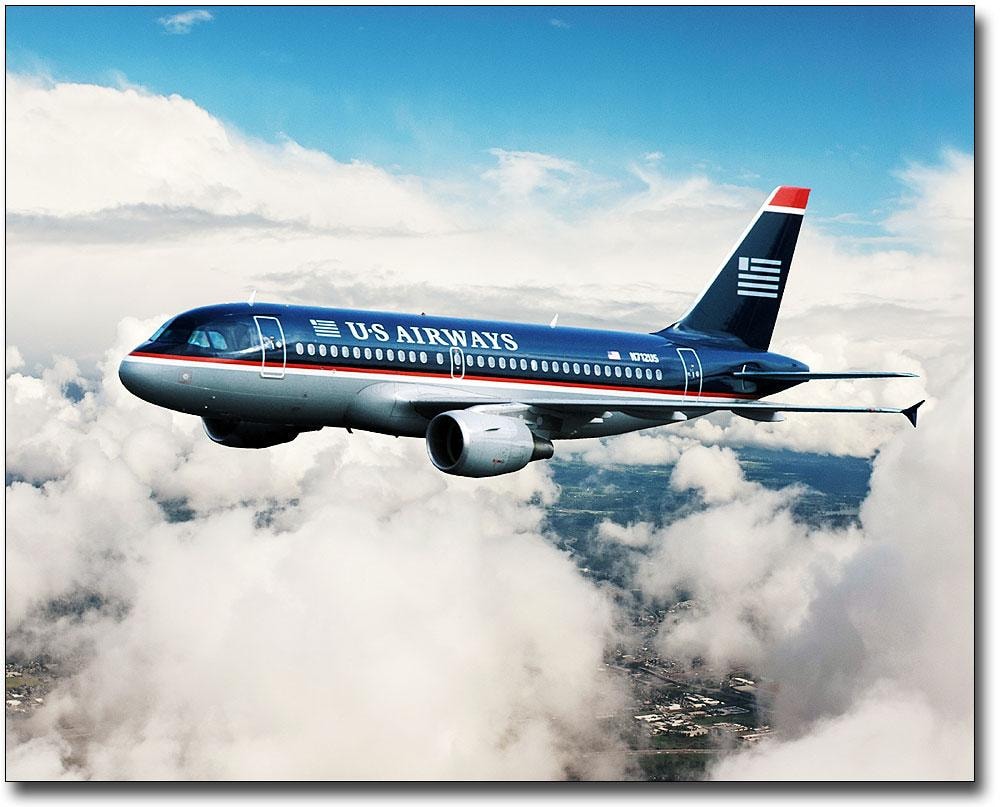
US Airways went through several livery changes over its long history, but its most distinctive scheme was the blue and grey design adopted in the 1990s, featuring a bold blue fuselage and a stylised flag motif on the tail. The later 'Cactus' scheme — a nickname derived from its ICAO code — was a clean, modern design that reflected the airline's merger with America West in 2005. The final US Airways livery, with its bold blue and silver, was one of the most attractive in American aviation.
The End
What Went Wrong
US Airways filed for bankruptcy twice after 9/11 — in 2002 and 2004 — before merging with America West in 2005. The merged airline retained the US Airways name but was effectively run by America West management. A second merger, with American Airlines in 2013, created the world's largest airline. The last US Airways flight — Flight 1939, a nod to its founding year — operated on 9 October 2015, ending 76 years of history.
Deregulation
Deregulation's Role
US Airways was shaped by deregulation more than almost any other carrier. Its predecessor, Allegheny Airlines, had been a regional carrier protected by regulation. Deregulation allowed it to expand aggressively, rebranding as USAir and then US Airways as it grew. But the same competitive pressures that enabled its growth also exposed its vulnerabilities — a high cost base, a fragmented route network, and intense competition from Southwest and other low-cost carriers on its most profitable routes.
Legacy
The Legacy
US Airways is perhaps the least mourned of the great lost airlines — partly because its end came through merger rather than collapse, and partly because the America West management that ran it in its final decade never quite captured the loyalty that Pan Am or TWA inspired. But for the millions of East Coast travellers who flew it for decades, US Airways was a constant companion — reliable, familiar, and ultimately irreplaceable. Its disappearance completed the consolidation of the American airline industry into a handful of mega-carriers, and closed a chapter that began with deregulation in 1978.
Frequently Asked Questions
Common Questions
What happened to US Airways?+
US Airways merged with American Airlines in December 2013, forming the world's largest airline. The merger was unusual in that US Airways was technically the acquirer — its management team, led by CEO Doug Parker, took control of the combined carrier despite American being the larger brand. The US Airways name disappeared in October 2015 when the last US Airways-branded flight landed.
Why did US Airways go bankrupt twice?+
US Airways filed for bankruptcy in August 2002, just eleven months after the 9/11 attacks devastated air travel demand. It emerged in 2003 but filed again in September 2004, unable to compete with low-cost carriers on its core East Coast routes. The second bankruptcy allowed it to slash costs dramatically. Its merger with America West in 2005 — while still in bankruptcy — was a novel solution that created a new carrier with US Airways' route network and America West's lower cost structure.
What was the Miracle on the Hudson?+
On 15 January 2009, US Airways Flight 1549 struck a flock of Canada geese shortly after takeoff from New York LaGuardia, losing thrust in both engines. Captain Chesley Sully Sullenberger made the decision to ditch in the Hudson River rather than attempt to reach an airport. All 155 passengers and crew survived. The incident became one of the most celebrated examples of airmanship in aviation history and was later depicted in Clint Eastwood's 2016 film Sully.
How did US Airways become American Airlines?+
US Airways and American Airlines announced their merger in February 2013 while American was in bankruptcy. The deal was initially blocked by the US Department of Justice on antitrust grounds, but a settlement in November 2013 allowed it to proceed with slot divestitures at key airports. The combined carrier operated as American Airlines Group, with Doug Parker as CEO. The integration took three years to complete, with the US Airways brand finally retired in 2015.