

Lost Airlines — Piedmont Airlines
Piedmont Airlines (1948–1989)
The Carolinas' beloved carrier — a regional pioneer that built its reputation on warmth, reliability, and the Pacemaker service — absorbed into USAir before it could fully capitalise on the deregulated era it had helped to shape.
Founded in Winston-Salem, NC
Cities served at peak
Merged into USAir
Heritage
The Pacemaker and the Piedmont Way
Founded in 1948 by Tom Davis in Winston-Salem, North Carolina, Piedmont Airlines built its identity around the American South and Mid-Atlantic. Its flagship Pacemaker service between Charlotte and New York became a byword for punctuality and Southern hospitality. Flying DC-3s and later Fairchild FH-227s, Piedmont was a textbook example of the regulated era working as intended — a regional carrier serving communities that the majors ignored, protected by CAB route allocations and fare structures that guaranteed a modest but stable return.
Identity
The Blue and Gold of the Carolinas
Piedmont's livery — a clean white fuselage with a bold blue cheatline and gold accent — was instantly recognisable across the Southeast. The stylised Piedmont script on the tail became a symbol of regional pride. When the airline transitioned to jets in the 1960s with the Boeing 727, it retained the same approachable identity that had made it beloved. Passengers from Charlotte, Raleigh, and Greensboro grew up with Piedmont; it was their airline in a way that Delta or Eastern never quite was.
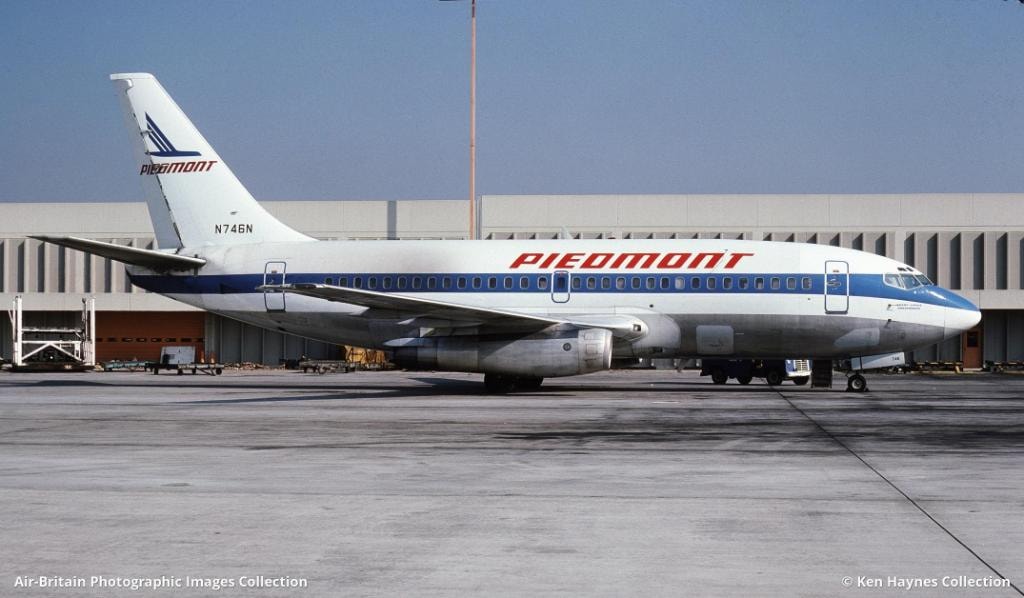
The End
Deregulation's Double-Edged Sword
The Airline Deregulation Act of 1978 initially seemed like an opportunity for Piedmont. Freed from CAB restrictions, it expanded aggressively — adding routes, acquiring Empire Airlines in 1985, and establishing Charlotte Douglas as a genuine hub. By 1987 it was carrying over 20 million passengers a year. But the same deregulation that unlocked growth also invited the majors into Piedmont's backyard. USAir, itself expanding rapidly, made a takeover bid in 1987. The merger was completed in 1989, and the Piedmont name — along with its distinctive livery and culture — was quietly retired.
Deregulation
A Victim of Its Own Success
Piedmont's story is one of deregulation's crueller ironies. The airline thrived initially in the new environment, growing faster than almost any other regional carrier. But that growth made it an attractive acquisition target. USAir paid $1.59 billion for Piedmont — a premium that reflected how well the airline had performed. The tragedy was not financial collapse but absorption: a successful, well-run airline with a genuine regional identity swallowed by a larger competitor that saw Charlotte as a strategic asset rather than a community it served. The Piedmont name survived only on a regional subsidiary, a ghost of the original.
Legacy
A Legacy of Southern Hospitality
Piedmont Airlines deserves to be remembered not as a failure but as a success story with an unhappy ending. It proved that a regional carrier could compete on quality and service, build genuine loyalty, and grow into a major force — only to be consumed by the consolidation wave that deregulation ultimately unleashed. The Piedmont name lives on today as a wholly-owned regional subsidiary of American Airlines, operating under the American Eagle brand. It is a faint echo of an airline that once meant something very specific to the people of the Carolinas.
Frequently Asked Questions
Common Questions
What happened to Piedmont Airlines?+
The original Piedmont Airlines was acquired by USAir in 1989 for $1.59 billion and fully absorbed into that carrier. The Piedmont name was later revived by USAir as a regional subsidiary. Today, a carrier called Piedmont Airlines still exists as a wholly owned subsidiary of American Airlines Group, operating regional flights as American Eagle — but it bears no operational continuity with the original Piedmont that served the Carolinas for four decades.
Where did Piedmont Airlines fly?+
The original Piedmont Airlines was a regional carrier based in Winston-Salem, North Carolina, serving the Carolinas, Virginia, Tennessee, and the broader US South-East. After deregulation it expanded aggressively, adding routes to the North-East, Midwest, and eventually transcontinental services. By the mid-1980s it had grown from a small regional carrier into a mid-sized national airline with hubs at Charlotte Douglas and Dayton, Ohio.
Was Piedmont Airlines a good airline?+
Piedmont had an excellent reputation for customer service and operational reliability. It was consistently rated among the top US carriers for on-time performance and passenger satisfaction in the 1980s. Its regional roots gave it a community-focused culture that larger carriers struggled to match. Aviation historians often cite Piedmont as an example of a well-run airline that was absorbed not because it failed, but because it succeeded — making it an attractive acquisition target.
Why did Piedmont merge with USAir?+
USAir acquired Piedmont in 1989 as part of a consolidation strategy to build a national network from its East Coast base. Piedmont's Charlotte hub and its strong presence in the South-East complemented USAir's North-East strength. The $1.59 billion price tag was considered high at the time, and many analysts argued USAir overpaid — a view that gained credence when the combined carrier struggled financially in the early 1990s.