

Lost Airlines — America West Airlines
America West Airlines (1983–2005)
The airline that deregulation built — launched in Phoenix in 1983 with a low-cost model and a sunburst livery, America West survived bankruptcy, reinvented itself, and ultimately became the unlikely vehicle through which US Airways was reborn.
Founded in Tempe, Arizona
Filed for Chapter 11
Merged with US Airways
Heritage
Born of Deregulation
America West Airlines was, in the most literal sense, a child of deregulation. It could not have existed before 1978. Founded in Tempe, Arizona in 1983 by Ed Beauvais, it launched with a fleet of Boeing 737s and a philosophy borrowed from Southwest: keep costs low, keep aircraft utilised, and pass the savings to passengers. Phoenix Sky Harbor became its hub, and the airline grew rapidly through the mid-1980s, adding transcontinental routes and establishing itself as a genuine low-cost alternative to the legacy carriers. At its peak it was the ninth-largest US carrier, serving over 100 destinations.
Identity
The Sunburst and the Desert Palette
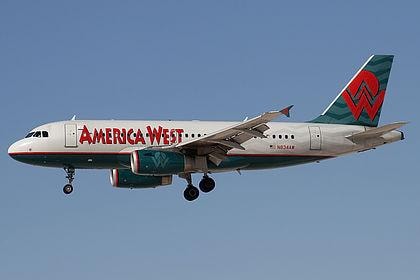
America West's livery was one of the most distinctive of the deregulation era. The original scheme — a bold sunburst on the tail in terracotta, turquoise, and gold against a white fuselage — captured the spirit of the American Southwest perfectly. It was warm, optimistic, and unlike anything the legacy carriers were flying. Later repaints toned down the palette, but the sunburst remained a constant. The livery was a statement of intent: this was a new kind of airline for a new era, unencumbered by the grey conservatism of the regulated past.
Bankruptcy & Survival
Bankruptcy, Survival, and Reinvention
America West filed for Chapter 11 bankruptcy protection in June 1991, a casualty of the Gulf War fuel crisis and the recession that followed. What happened next was remarkable: unlike Eastern, Pan Am, or Braniff, it survived. With the help of the State of Arizona, a $55 million federal loan guarantee, and a restructured labour agreement, the airline emerged from bankruptcy in 1994. It reinvented itself as a hybrid carrier — not quite a legacy airline, not quite a low-cost carrier — and returned to profitability. By the early 2000s it was carrying over 20 million passengers a year from its Phoenix and Las Vegas hubs.
Deregulation
The Airline Deregulation Created
America West's entire existence was a product of the 1978 Deregulation Act. Before deregulation, the CAB would never have granted route certificates to a startup with no history and a low-cost model. The airline demonstrated both the promise and the peril of the deregulated environment: it created genuine competition, drove down fares on transcontinental routes, and served markets the legacy carriers had neglected. But it also showed how vulnerable new entrants were to external shocks — fuel price spikes, recessions, and the structural disadvantages of competing against carriers with decades of accumulated infrastructure and loyalty programmes.
Legacy
The Airline That Outlived Its Name
America West's final act was its strangest. In 2005, the airline — still operating under Chapter 11 protection after a second bankruptcy filing — acquired the far larger US Airways, which had itself just emerged from bankruptcy. The combined entity took the US Airways name, but it was America West's management team, led by Doug Parker, that ran it. Parker went on to acquire American Airlines in 2013, creating the world's largest airline. In a very real sense, the scrappy Phoenix startup that deregulation made possible ended up controlling the global aviation giant. The America West name disappeared, but its DNA survived.
Frequently Asked Questions
Common Questions
What happened to America West Airlines?+
America West merged with US Airways in September 2005 in a highly unusual transaction — America West, the smaller carrier, effectively acquired the bankrupt US Airways, with the combined airline operating under the US Airways name. America West's CEO Doug Parker led the merged carrier. The America West brand disappeared entirely, though its Phoenix hub and low-cost operational culture became central to the new US Airways.
Was America West a low-cost airline?+
America West was one of the original deregulation-era low-cost carriers, founded in 1983 specifically to exploit the opportunities created by the 1978 Airline Deregulation Act. It offered lower fares than the legacy carriers on its Phoenix-based routes, though it was never as aggressively low-cost as Southwest. It occupied a middle ground — lower fares than United or American, but more amenities than the pure no-frills carriers.
Did America West go bankrupt?+
Yes. America West filed for Chapter 11 bankruptcy in June 1991, a victim of the Gulf War oil price spike and the recession of the early 1990s. It was the first major deregulation-era carrier to file for bankruptcy. Unusually, it emerged from bankruptcy in August 1994 as a going concern, having restructured its costs and renegotiated contracts. Its survival was considered remarkable at the time.
Why was America West based in Phoenix?+
Phoenix was a deliberate strategic choice. When America West launched in 1983, Phoenix Sky Harbor was a rapidly growing airport in a booming Sun Belt city, with relatively low landing fees and gate costs compared to congested North-East hubs. The city's position as a connecting point between the West Coast and the rest of the US made it ideal for a hub-and-spoke operation. America West's founders correctly identified that deregulation would create opportunities in underserved markets, and Phoenix fit that profile perfectly.