

1927 – 1991
Pan American World Airways
For six decades, Pan Am was America's unofficial flag carrier — the airline that opened the world to ordinary travellers and defined what international flight could be.
Years of service
Destinations worldwide
Lockerbie bombing year
Heritage
The Golden Era
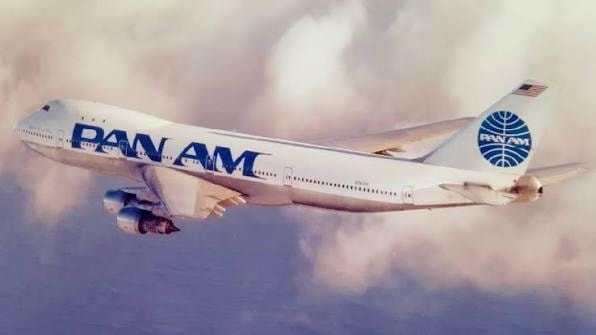
Pan Am was more than an airline — it was a symbol of American ambition. Founded by the visionary Juan Trippe in 1927, it pioneered transatlantic flight, introduced the Boeing 747 to commercial service in 1970, and operated the most glamorous routes on earth. The Pan Am Clipper flying boats of the 1930s and 1940s carried wealthy passengers across oceans in a style that rivalled ocean liners. Its stewardesses were celebrities. Its blue globe logo was recognised worldwide.
Identity
The Iconic Livery
The Pan Am blue globe — simple, bold, instantly recognisable — remains one of the most iconic logos in aviation history. The white and blue livery, with its distinctive globe on the tail, projected confidence and modernity. Even today, the Pan Am brand is licensed for merchandise, a testament to the emotional hold it still has on those who flew it.
The End
What Went Wrong
Deregulation hit Pan Am harder than almost any other carrier. Without a domestic route network to feed its international flights, it was structurally vulnerable from the start. The 1973 oil crisis devastated its finances. The 1988 Lockerbie bombing, which destroyed Flight 103 over Scotland and killed 270 people, was a catastrophic blow to bookings and morale. Pan Am sold its Pacific routes to United in 1985 and its transatlantic routes to Delta in 1991 — and then, on 4 December 1991, it filed for bankruptcy and ceased operations.
Deregulation
Deregulation's Role
Pan Am's tragedy was partly structural. It had built its empire on international routes, which were regulated by bilateral government agreements and therefore protected from domestic competition. When deregulation opened domestic routes to all comers, Pan Am found itself without the feeder network that domestic carriers used to fill their international flights. It tried to fix this by acquiring National Airlines in 1980, but the purchase was expensive and the integration troubled. Deregulation didn't kill Pan Am alone — but it removed the protections that might have saved it.
Legacy
The Legacy
Pan Am's collapse was mourned like a national bereavement. It had carried Americans to the moon landings in spirit, opened Asia to mass tourism, and made the world feel smaller. Its disappearance left a gap in the American psyche that no subsequent carrier has filled. The blue globe still appears on bags, jackets, and posters — a reminder of when flying was an adventure, and Pan Am was its greatest guide.
Frequently Asked Questions
Common Questions
Why did Pan Am go bankrupt?+
Pan Am's collapse was the result of compounding crises: the 1973 oil shock devastated its fuel-heavy long-haul network, the 1988 Lockerbie bombing destroyed passenger confidence, and deregulation stripped away the protected routes that had guaranteed revenue. Unable to compete on domestic routes — which it had been barred from flying for decades — Pan Am had no feeder traffic for its international flights. It filed for bankruptcy in January 1991 and ceased operations in December of that year.
What happened to Pan Am's routes and assets?+
Pan Am sold its Pacific routes to United Airlines in 1985 for $750 million, its Frankfurt hub and London Heathrow slots to Lufthansa and United in 1990, and its transatlantic routes to Delta in 1991. The Pan Am brand was briefly revived by a new carrier in 1996 but that too failed. The iconic Pan Am Building in New York was sold and is now the MetLife Building.
Was Pan Am the world's greatest airline?+
Pan Am was unquestionably the most influential American airline of the 20th century. It pioneered transatlantic jet service with the Boeing 707 in 1958, launched the jumbo jet era with the 747 in 1970, and set the standard for international aviation glamour. At its peak it operated to 86 countries. Whether it was the greatest is subjective, but its technological and cultural impact on commercial aviation is unmatched.
Could Pan Am have survived deregulation?+
Possibly, but it would have required a fundamental restructuring. Pan Am's fatal weakness was its lack of a domestic network — a direct consequence of the regulatory era that confined it to international routes. When deregulation allowed domestic competition, Pan Am had no hub-and-spoke feeder system. Its 1985 acquisition of National Airlines was meant to fix this but proved too expensive. With a strong domestic base and leaner operations, survival was conceivable; without one, the odds were always against it.