

Lost Airlines — Frontier Airlines
Frontier Airlines (1950–1986)
The original Frontier Airlines was the Rocky Mountain West's own carrier — a regional airline that connected Denver with the small cities and towns of the interior that the major carriers ignored. For 36 years it served communities that had no other air service, before deregulation's economics made its model unviable and Continental absorbed what remained.
Founded in Denver
Western states served at peak
Absorbed by Continental
Heritage
The Airline of the Mountain West
Frontier Airlines was formed in 1950 through the merger of several small regional carriers serving the Rocky Mountain states. Based in Denver, it built a network that connected the major cities of the West — Denver, Albuquerque, Salt Lake City, El Paso — with the smaller communities that the trunk carriers had no interest in serving: Casper, Billings, Grand Junction, Durango. Under CAB regulation, Frontier was protected on these routes and could cross-subsidise its thinner services with revenue from its busier ones. It was not a glamorous airline, but it was an essential one — for many communities in Wyoming, Montana, and the Dakotas, Frontier was the only air service available.
Identity
The Colours of the Western Sky
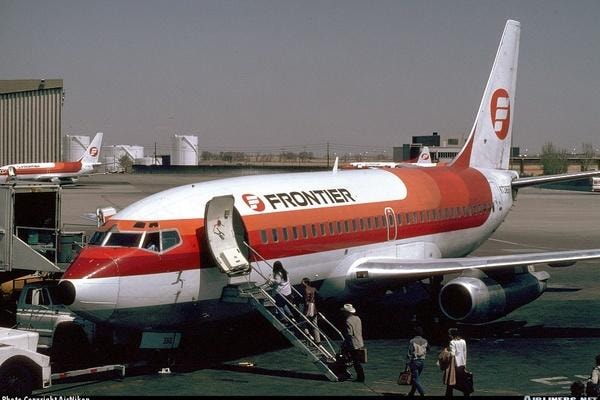
Frontier's most distinctive livery, introduced in the 1970s, featured a warm golden yellow fuselage with a brown cheatline and the Frontier name in bold lettering. The tail carried a stylised mountain design — a direct reference to the Rocky Mountain terrain the airline served. The colour scheme was warm and earthy, reflecting the landscapes of the American West rather than the corporate blues and greys of the major carriers. It was an honest livery for an honest airline: unpretentious, regional, and proud of its geography.
Collapse
When the Cross-Subsidy Disappeared
Frontier's business model depended on the CAB's route allocation system, which allowed it to earn reasonable returns on its busier routes and use that revenue to support its thinner, essential services to small communities. Deregulation destroyed this model in two ways. First, new low-cost entrants — including People Express and Midway — began competing aggressively on Frontier's profitable routes, compressing margins. Second, the obligation to serve thin routes disappeared, but so did the revenue that had funded them. Frontier attempted to restructure and compete as a low-cost carrier, but it lacked the scale and the cost base to succeed. In 1985 it filed for bankruptcy, and in 1986 it was acquired by Continental, which absorbed its routes and retired the brand.
Deregulation
The Regional Carrier's Dilemma
Frontier's experience illustrates one of deregulation's most significant unintended consequences: the destruction of the cross-subsidy system that had maintained air service to small communities. Under regulation, the CAB had used route awards to ensure that carriers serving profitable routes also served unprofitable ones. Deregulation ended this arrangement, and the result was the rapid withdrawal of service from hundreds of small communities across the United States. Congress attempted to address this through the Essential Air Service programme, which subsidised service to the most isolated communities, but it was a partial and imperfect substitute for the system that Frontier had embodied.
Legacy
The Airline That Served Where Others Would Not
The original Frontier Airlines is not remembered with the same nostalgia as Pan Am or TWA, and it never had their glamour or their global reach. But its loss was felt more acutely by the communities it served than the loss of any transatlantic carrier. For the ranchers of Wyoming and the miners of Montana, Frontier was not a luxury — it was a lifeline. The current Frontier Airlines, founded in 1994, has no operational or ownership connection to the original. It is a ultra-low-cost carrier that bears the name but not the mission of its predecessor. The original Frontier's story is a reminder that deregulation, for all its benefits, also had costs that were borne disproportionately by the communities least able to absorb them.
Frequently Asked Questions
Common Questions
Is the current Frontier Airlines related to the original?+
No. The current Frontier Airlines, founded in 1994 and based in Denver, has no operational, financial, or ownership connection to the original Frontier Airlines that operated from 1950 to 1986. The current carrier acquired the Frontier name and brand after the original ceased operations, but it is an entirely different company with a different business model — an ultra-low-cost carrier rather than a regional service airline.
What communities did the original Frontier Airlines serve?+
Frontier served a wide network of cities and towns across the Rocky Mountain West and Great Plains, including Denver, Albuquerque, Salt Lake City, El Paso, Tucson, Billings, Casper, Grand Junction, Durango, Rapid City, and many smaller communities in Wyoming, Montana, Colorado, New Mexico, and the Dakotas. Many of these communities had no alternative air service, making Frontier's routes genuinely essential rather than merely commercial.
How did deregulation affect small communities that Frontier served?+
Deregulation led to the withdrawal of scheduled air service from hundreds of small US communities, including many that Frontier had served. Without the CAB's cross-subsidy system, carriers had no financial incentive to serve routes that could not cover their costs. Congress created the Essential Air Service programme in 1978 to subsidise service to the most isolated communities, but many towns that had enjoyed regular Frontier service lost it entirely or saw it reduced to infrequent, subsidised flights on small turboprop aircraft.
When did Continental acquire Frontier Airlines?+
Continental Airlines acquired Frontier Airlines in 1986, after Frontier had filed for Chapter 11 bankruptcy protection in 1985. Continental absorbed Frontier's routes and aircraft into its own network and retired the Frontier brand. The acquisition was part of Continental's strategy to expand its Denver hub, which became one of the most important in the United States. The Frontier name lay dormant until 1994, when a new carrier was founded using the brand.